
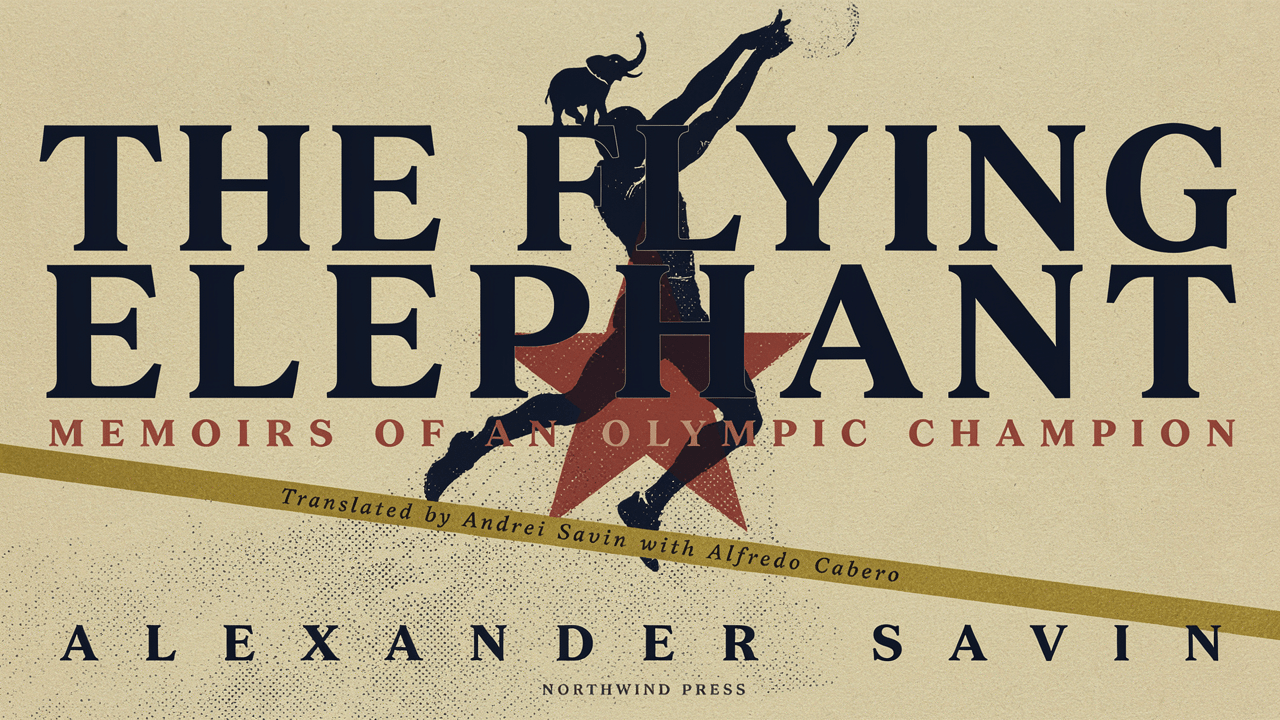
The flying elephant memoirs of an olympic champion alexander savin is a sports memoir built around the life and experiences of Soviet volleyball great Alexander Savin. Savin won Olympic silver at Montreal 1976 and Olympic gold at Moscow 1980 before entering the International Volleyball Hall of Fame in 2010.
The English version grew from a personal translation project led by Savin’s half-brother Andrei, with help from collaborators including Alfredo Cabero. Their first-hand accounts describe the project as an effort to preserve Savin’s memories and a major period of international volleyball history.What Is The Flying Elephant Memoirs of an Olympic Champion Alexander Savin?
The flying elephant memoirs of an olympic champion alexander savin is a sports memoir built around the life and experiences of Soviet volleyball great Alexander Savin. Savin won Olympic silver at Montreal 1976 and Olympic gold at Moscow 1980 before entering the International Volleyball Hall of Fame in 2010.
The English version grew from a personal translation project led by Savin’s half-brother Andrei, with help from collaborators including Alfredo Cabero. Their first-hand accounts describe the project as an effort to preserve Savin’s memories and a major period of international volleyball history.
Table of Contents
Introduction
Olympic medals show victory, but they rarely explain the years behind it. Training, defeat, teammates, coaches, pressure, family, and changing identity often disappear from the record. The flying elephant memoirs of an olympic champion alexander savin helps fill that gap by connecting one champion’s memories with the story of Soviet volleyball. For sports readers, it offers something valuable: the perspective of a man who competed at the highest level and lived through both Olympic disappointment and triumph.
What Is The Flying Elephant Memoirs of an Olympic Champion Alexander Savin?
The flying elephant memoirs of an olympic champion alexander savin is the English version of Alexander Savin’s memoir about his life, volleyball career, teammates, coaches, competitions, and experiences inside Soviet sport.
Rather than treating Savin only as a medal winner, the memoir preserves the people and experiences surrounding his career. That gives it value as both a personal sports story and a record of an important volleyball era.
Andrei Savine described translating the memoir as a family project that became increasingly personal as he learned about his half-brother’s teammates, coaches, friends, and sporting world. He said the English edition was made available in Kindle format.
Who Is Alexander Savin?
Alexander Borisovich Savin was born on July 1, 1957, in Taganrog, Russia. The International Volleyball Hall of Fame recognizes him as one of the major male indoor players of his generation.
His career became closely connected with the Soviet Union’s return to the top of international men’s volleyball. Savin competed during an era when the national team collected major Olympic, world, and European honors.
The Hall of Fame officially enshrined him in 2010. That recognition gives readers important context when approaching the flying elephant memoirs of an olympic champion alexander savin: its author is not simply remembering professional sport from the sidelines. He participated at its highest competitive level.
Alexander Savin’s Career at a Glance
| Detail | Verified Information |
| Full name | Alexander Borisovich Savin |
| Born | July 1, 1957 |
| Birthplace | Taganrog, Russia |
| Sport | Indoor volleyball |
| National team | Soviet Union |
| Montreal 1976 | Olympic silver medal |
| Moscow 1980 | Olympic gold medal |
| Major role | Soviet men’s national volleyball player |
| Hall of Fame | International Volleyball Hall of Fame |
| Hall of Fame year | 2010 |
| Memoir | The Flying Elephant |
| English project | Family-led translation |
| English availability | Kindle edition described by translation team |
| Main subjects | Volleyball, teammates, coaches, memories, Soviet sport and legacy |
Savin’s official Hall of Fame biography confirms his Olympic achievements and documents his place in Soviet volleyball history.
Why Was the 1976 Montreal Olympics Important?
The 1976 Montreal Olympics gave Savin one of his first major Olympic experiences. The Soviet men’s team entered the Games with high expectations but ultimately earned silver.
The International Volleyball Hall of Fame notes that Savin competed under coach Yuri Tchesnokov during the Montreal campaign. The result became part of a larger competitive story rather than the end of it.
That makes the 1976 Games especially relevant to the flying elephant memoirs of an olympic champion alexander savin. An Olympic career built only around victory would tell a simpler story. Silver in Montreal followed by gold four years later creates a stronger picture of persistence, adjustment, and team development.
What Happened at the 1980 Moscow Olympics?
Four years after Montreal, Savin and the Soviet team competed at the 1980 Moscow Games.
This time, the Soviet Union finished at the top of the men’s volleyball tournament and won Olympic gold. The International Volleyball Hall of Fame credits Savin as an important part of the Soviet team’s return to Olympic supremacy.
That victory became one of the defining achievements of Savin’s playing career.
For readers of the flying elephant memoirs of an olympic champion alexander savin, Moscow represents more than another result in a statistics table. It provides the personal setting for understanding how elite athletes respond after an earlier Olympic disappointment.
Why Is Alexander Savin Important to Volleyball History?
Savin played during one of the strongest periods in Soviet men’s volleyball.
His Hall of Fame biography places him within a team that competed for major international titles and restored Soviet Olympic success. His career therefore connects personal achievement with a much larger sporting system.
That distinction matters. A sports memoir becomes more valuable when the writer witnessed major historical events firsthand.
Savin experienced:
- Olympic competition at Montreal 1976.
- Olympic competition at Moscow 1980.
- Elite Soviet team training.
- International volleyball at championship level.
- Different generations of players and coaches.
- The pressures surrounding national-team success.
- Life after elite competition.
Those experiences provide the foundation for the flying elephant memoirs of an olympic champion alexander savin.
What Makes The Flying Elephant Different From a Simple Sports Biography?
A biography is normally written by someone examining another person’s life. A memoir gives the person who experienced events greater control over how those events are remembered.
That distinction is important here.
The flying elephant memoirs of an olympic champion alexander savin presents Savin’s own sporting world through memory. Readers are not limited to scores, medals, and tournament rankings.
The translation project also appears to have been driven by preservation rather than celebrity marketing. Andrei Savine explained that translating his half-brother’s memoir allowed him to become familiar with people from Alexander’s life whose stories might otherwise disappear from public memory.
How Did The Flying Elephant Reach English Readers?
The English version has an unusual history.
According to Andrei Savine’s first-hand account, he spent more than a year working on the translation of his half-brother’s memoir. He collaborated with Alfredo Cabero and his wife during the project.
Cabero separately described his involvement with both the Russian book and the later English translation. He explained that Russian expressions and cultural references sometimes required careful interpretation rather than simple word-for-word translation.
This background adds another layer to the flying elephant memoirs of an olympic champion alexander savin. It is not merely an English reprint. Its movement from Russian into English required people close to the project to carry sporting and cultural meaning across languages.
Why Was Translating Alexander Savin’s Story Challenging?
Translation becomes harder when a memoir contains expressions tied closely to one country, generation, or culture.
Alfredo Cabero wrote that Savin used Russian sayings and expressions that did not always have direct English equivalents. The team needed to understand what Savin intended before creating natural English wording.
This matters because a literal translation can preserve words while losing meaning.
A sports memoir may contain references to:
- Coaching language.
- Team jokes.
- Soviet institutions.
- Cultural habits.
- Historical events.
- Training methods.
- Personal relationships.
- Expressions unique to Russian speech.
Preserving those layers gives an English reader a better chance of understanding Savin’s original perspective.
What Themes Does The Flying Elephant Explore?
The flying elephant memoirs of an olympic champion alexander savin naturally connects several themes through Savin’s life and career.
Teamwork
Volleyball cannot be won by one player. Savin’s story exists alongside setters, attackers, defenders, coaches, staff, and opponents.
Discipline
Olympic success requires years of repeated training rather than one exceptional performance.
Defeat
The contrast between Montreal silver and Moscow gold shows why losses can remain important parts of an athlete’s story.
Memory
Savin’s memoir preserves people who may receive little attention in modern sports coverage.
Soviet sports culture
The book gives English readers a personal route into an athletic system that existed under very different social and political conditions.
Family
The English translation itself became part of Savin’s family story because his half-brother helped bring it to another audience.
What Role Do Teammates and Coaches Play in the Memoir?
One of the most interesting aspects of the translation project is its attention to people around Savin.
Andrei Savine explained that while working on the memoir he came to know the stories of Savin’s teammates, coaches, and friends. His remarks suggest that preserving those people became an important purpose of the English project.
That approach makes the flying elephant memoirs of an olympic champion alexander savin useful for readers interested in team culture.
Championships rarely belong to one person. A medal may carry a single athlete’s name, but performance develops through shared preparation, tactical understanding, coaching, competition for positions, and trust.
Why Does the Soviet Volleyball Setting Matter?
The Soviet Union was one of international volleyball’s major powers.
Savin’s Hall of Fame biography places his career within the country’s long history of Olympic success. After earlier Soviet Olympic titles, Savin became part of the team that returned to the top of the podium at Moscow 1980.
The setting therefore gives the memoir historical depth.
Readers can approach the story through several lenses:
- Olympic sports history.
- Soviet athletics.
- Volleyball development.
- Coaching culture.
- International competition.
- Cold War-era sport.
- Athlete identity.
- Team leadership.
This broader context helps explain why Savin’s memories matter beyond his personal medal collection.
What Can Athletes Learn From Alexander Savin?
Readers should be careful about turning every champion’s story into a universal formula. Training environments, sports science, rules, and athlete welfare standards change.
Still, Savin’s competitive path highlights several lasting ideas.
First, elite performance develops over time. The journey from Montreal silver to Moscow gold did not happen in one match.
Second, team success requires shared responsibility. Volleyball punishes teams that depend entirely on one player.
Third, difficult results remain useful history. A defeat can explain later decisions as clearly as a victory.
Fourth, sporting knowledge deserves preservation. Memories from athletes and coaches can record details that final score sheets never capture.
These lessons give the flying elephant memoirs of an olympic champion alexander savin value for athletes as well as sports-history readers.
Why Might Coaches Find the Memoir Valuable?
Coaches often study winning systems. A first-person memoir offers something statistics cannot provide: the athlete’s experience inside that system.
Savin competed under high expectations and alongside leading international players. His memories can therefore help coaches think about the relationship between preparation, teamwork, leadership, pressure, and performance.
Readers should not copy Soviet-era coaching methods without context. Modern coaching also needs to consider athlete safety, psychology, recovery, communication, and current sporting standards.
The real value lies in comparison. Coaches can ask what changed, what still works, and what should remain in the past.
Is The Flying Elephant Only for Volleyball Fans?
No.
Volleyball fans are the most obvious audience, but the flying elephant memoirs of an olympic champion alexander savin also connects with readers interested in Olympic history, Soviet history, athlete development, coaching, leadership, translation, and sports culture.
The memoir may appeal to:
- Volleyball players.
- Volleyball coaches.
- Olympic sports fans.
- Sports historians.
- Students of Soviet history.
- Readers of athlete autobiographies.
- Leadership readers.
- Sports journalists.
- Researchers studying international volleyball.
- Readers interested in translated memoirs.
The translation story also gives the book an unusual family dimension that extends beyond competition.
Why Is the English Edition Historically Useful?
Sports history depends on access.
A memoir available only in Russian naturally reaches fewer English-speaking volleyball readers. Translation expands the number of athletes, coaches, historians, and fans who can engage with Savin’s memories.
Andrei Savine described the English project as his contribution to preserving a legacy. Alfredo Cabero similarly described the work as a way to keep Savin’s sporting history available to future generations.
That purpose gives the flying elephant memoirs of an olympic champion alexander savin documentary value in addition to its value as entertainment.
Is The Flying Elephant Available on Kindle?
Yes. People directly involved in the English translation have stated that the completed English edition became available through Amazon Kindle.
Readers should check the current regional Amazon listing before purchasing because price, availability, device compatibility, and digital-store conditions can change.
A useful pre-purchase checklist is:
- Confirm Alexander Savin is named as the author.
- Check that the edition language is English.
- Confirm the Kindle format.
- Review the current product information.
- Check device compatibility.
- Read any available sample before purchasing.
View the referenced Amazon Kindle listing
What Makes Alexander Savin a Reliable First-Person Source?
Experience is central to the value of an athlete memoir.
Savin competed in two Olympic Games and won a medal at both. He later received formal recognition from the International Volleyball Hall of Fame, which enshrined him in 2010.
That does not mean every memory should be treated like an objective historical record. Memoirs naturally reflect personal memory and perspective.
However, Savin’s direct participation gives the flying elephant memoirs of an olympic champion alexander savin strong first-person authority when describing his own experiences, relationships, emotions, and sporting environment.
Complete Book and Career Overview
| Question | Answer |
| Who wrote the memoir? | Alexander Savin |
| What sport did Savin play? | Indoor volleyball |
| Which country did he represent? | Soviet Union |
| Did he compete at the Olympics? | Yes |
| What happened in 1976? | Soviet Union won men’s volleyball silver |
| What happened in 1980? | Soviet Union won men’s volleyball gold |
| Is Savin in the Hall of Fame? | Yes |
| When was he inducted? | 2010 |
| What is the memoir called? | The Flying Elephant |
| Was it translated into English? | Yes |
| Who led the translation project? | Andrei Savine |
| Was the translation a family project? | Yes, according to Andrei’s account |
| Is an English digital edition available? | The translation team described a Kindle edition |
| Main historical setting | Soviet and international volleyball |
| Major themes | Competition, teamwork, memory, coaching and sporting legacy |
| Best audience | Volleyball fans, coaches, athletes and sports-history readers |
FAQs
What is The Flying Elephant Memoirs of an Olympic Champion Alexander Savin?
The flying elephant memoirs of an olympic champion alexander savin is Alexander Savin’s personal sports memoir, available to English readers through a family-led translation project.
It explores a life connected to elite Soviet volleyball, Olympic competition, teammates, coaches, personal experiences, and sporting memory.
Did Alexander Savin really win an Olympic gold medal?
Yes. Alexander Savin won Olympic gold with the Soviet men’s volleyball team at Moscow 1980.
He had previously earned silver at Montreal 1976. The International Volleyball Hall of Fame documents both achievements.
Was Alexander Savin inducted into the Volleyball Hall of Fame?
Yes. The International Volleyball Hall of Fame inducted Alexander Savin in 2010 as a male indoor player.
His official profile recognizes his contribution to Soviet and international volleyball.
Who translated The Flying Elephant into English?
Andrei Savine led the English translation project with help from collaborators.
Andrei described working with Alfredo Cabero and his wife during the translation. Cabero has also published his own first-hand account of participating in the project.
Is the Alexander Savin memoir available as a Kindle book?
Yes. People directly involved in the translation state that the English edition was released in Kindle format through Amazon.
Current price and regional availability should be checked directly with Amazon because digital-store listings can change.
Who should read The Flying Elephant?
The memoir is best suited to volleyball fans, athletes, coaches, Olympic-history readers, and people interested in Soviet sport.
Readers interested in translation, family history, leadership, and preserving forgotten sporting stories may also find it valuable.
Author, Research Method and Trust Signals
Article author: Sports History Editorial Team
Research focus: Olympic volleyball, athlete memoirs, sports history and source verification
Fact-check date: September 9, 2026
Research approach: Major factual claims were checked against the International Volleyball Hall of Fame and first-hand statements from participants in the English translation project.
Primary and First-Hand Sources
International Volleyball Hall of Fame — Alexander Savin
Official Hall of Fame biography confirming Savin’s birth information, playing career, Olympic history, and 2010 induction.
Read Savin’s official Hall of Fame profile
Andrei Savine — English translation project
Savin’s half-brother describes leading the translation, the family connection behind the project, its Kindle availability, and the effort to preserve volleyball history.
Alfredo Cabero — Translation and editorial collaborator
Cabero provides a first-hand description of working on the Russian and English projects, including the difficulties of translating Russian cultural expressions accurately.
These sources were prioritized because they either represent the official sporting institution recognizing Savin or people directly involved in producing the English edition.
Final Takeaway
The flying elephant memoirs of an olympic champion alexander savin is valuable because Alexander Savin’s story extends far beyond one gold medal. His career connects the 1976 Montreal silver, the 1980 Moscow victory, elite Soviet volleyball, teammates, coaches, family, and the preservation of sporting history.
The English translation adds another meaningful chapter. What began as Andrei Savine’s effort to translate his half-brother’s memories became a way to preserve stories from a generation of volleyball players for new readers.
For readers interested in Olympic competition, volleyball history, coaching culture, or first-person sports memoirs, The Flying Elephant offers a rare perspective from someone who experienced championship-level sport from inside the team.












Leave a Reply